
Data governance is a comprehensive approach that comprises the principles, practices and tools to manage an organization’s data assets throughout their lifecycle. By aligning data-related requirements with business strategy, data governance provides superior data management, quality, visibility, security, and compliance capabilities across the organization.
Implementing an effective data governance strategy allows organizations to make data readily available for data-driven decision-making while safeguarding data assets from unauthorized access and ensuring compliance with regulatory requirements. In doing so, organizations can gain a competitive advantage and earn and maintain customer trust through strong data and privacy practices.
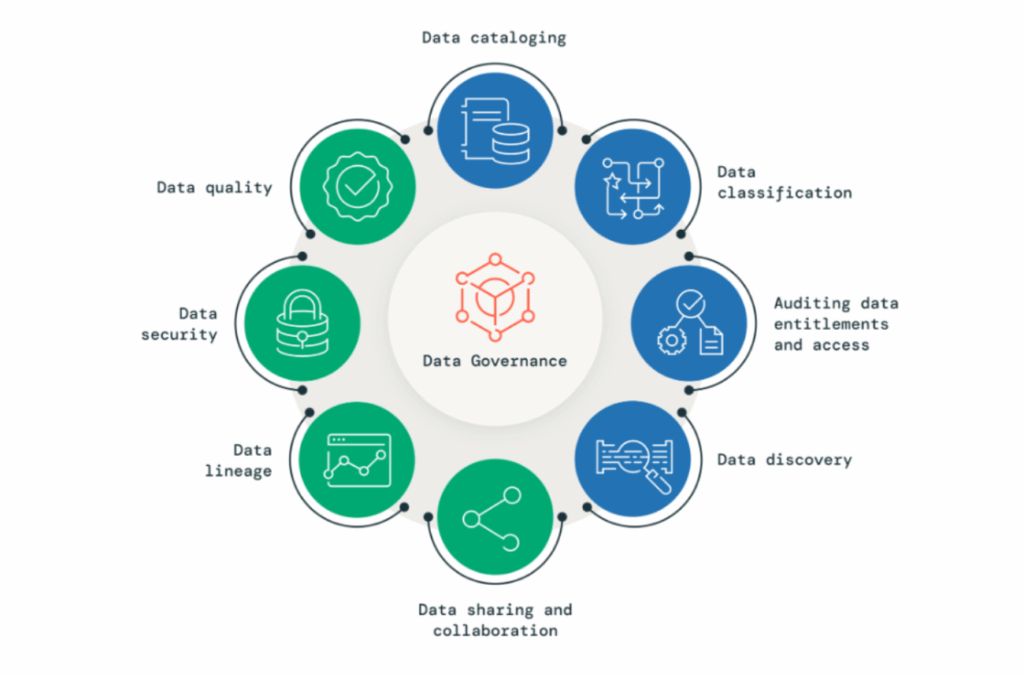
A data governance solution can provide several key capabilities to an organization; this article is focused on two important categories:
Centralized Data Catalog
A unified catalog that enforces access controls for sensitive data (such as PII), data quality management support via built-in testing, monitoring and enforcement to ensure accurate and reliable data is available.
Data Sharing
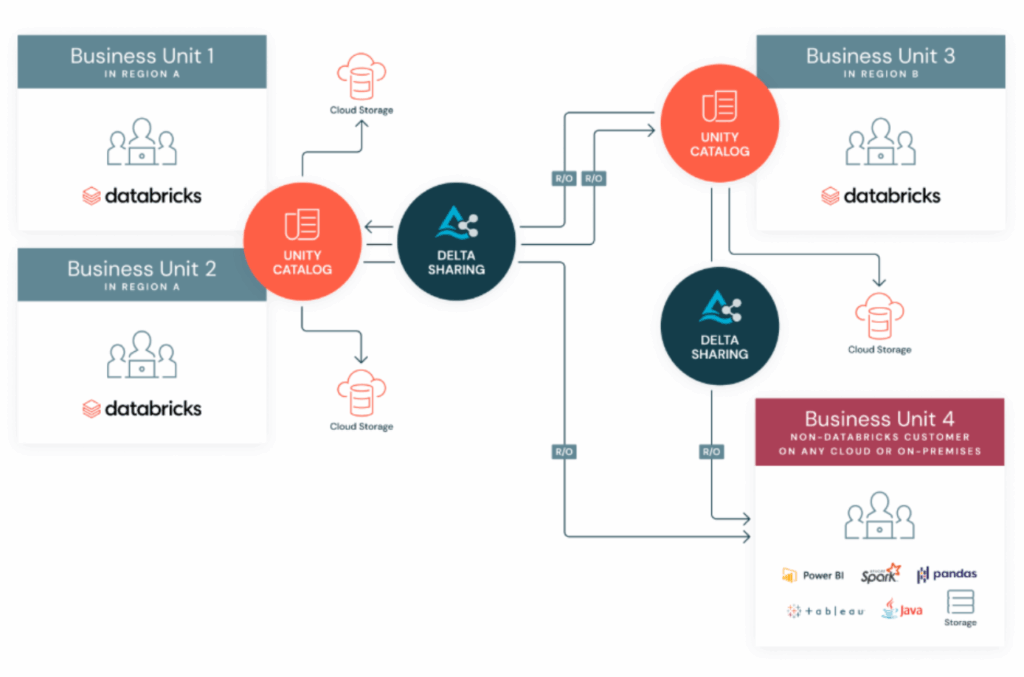
Supports secure, fine-grained data sharing across clouds, regions, and platforms, reducing duplication and preventing data silos from forming.
Centralized Data Cataloging – Evolution of Databricks’ Governance Model
Databricks’ answer to modern data governance is Unity Catalog, designed to help organizations elevate their governance maturity through a unified governance layer across the Databricks Data Intelligence Platform.
Before Unity Catalog, Databricks, like most data platforms of its era, relied on a workspace-scoped Hive Meta-store to manage metadata and access control. This model reflected the industry’s first-generation approach to governance, where policies and metadata were typically managed locally within individual workspaces or environments. While this setup worked well for isolated analytics and smaller teams, it made cross-workspace visibility and enterprise-wide governance more complex as organizations scaled.
Unity Catalog represents a major step forward, introducing a centralized meta-store that can be securely connected across multiple workspaces. This architecture reduces duplication of effort and enables consistent, organization-wide governance. Within workspaces, Unity Catalog’s support for multiple catalogs brings greater structure, making it easier for teams to apply top-down security and organizational standards to data assets.
Since launch, Databricks has continuously expanded Unity Catalog’s capabilities with innovations like end-to-end data lineage, centrally enforced row- and column-level security, and rich metadata for improved data discovery, empowering organizations to confidently manage data across domains.
Unity Catalog also leverages Delta Sharing, Databricks’ open-source protocol for secure, cross-platform data sharing. This helps eliminate data silos, foster seamless collaboration, and minimize vendor lock-in by enabling interoperability beyond Databricks itself.
Data Sharing – Extending Governance Through Clean Rooms
Soon after introducing Unity Catalog and Delta Sharing, Databricks launched Clean Rooms, a major innovation built directly on Delta Sharing.
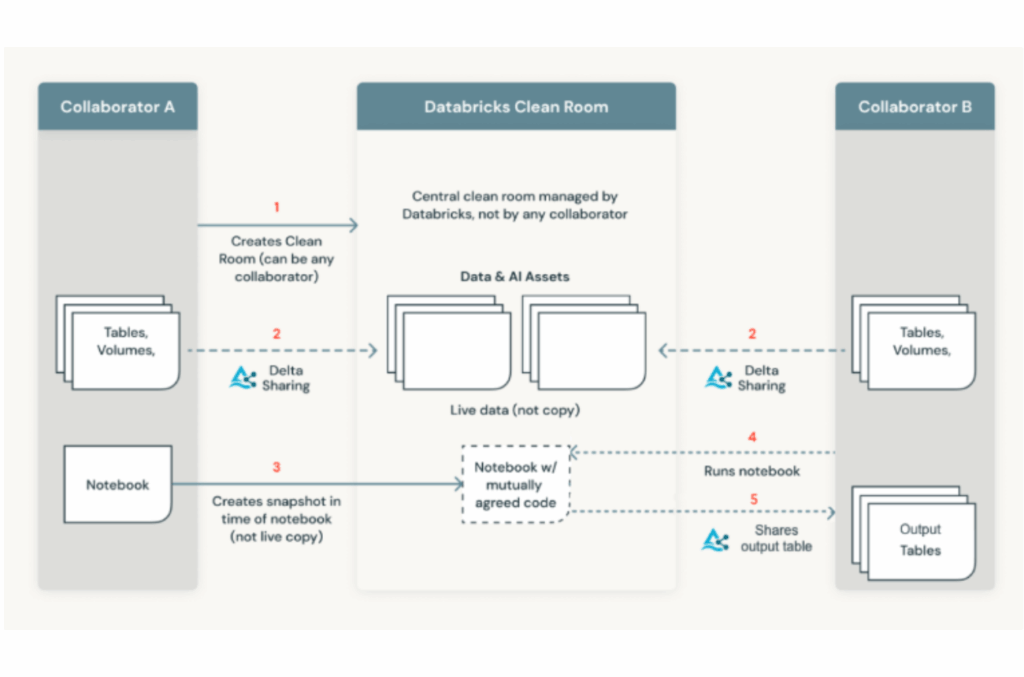
Clean Rooms offer organizations a secure, privacy-preserving environment to share and collaborate on data. They allow multiple parties, both internal teams and external partners, to work together on sensitive enterprise data without exposing or directly sharing their underlying datasets.
Traditional data collaboration tools often came with trade-offs. They struggled to scale, were limited to SQL-only interactions, and typically required data replication. Clean Rooms overcome these challenges by enabling governed collaboration across multiple clouds and platforms, supporting any language or workload, and operating efficiently at enterprise scale.
In a Clean Room, collaborators never access each other’s raw data. They can view limited schema metadata, such as column names and data types, but all computations occur through approved notebook code executed within the Clean Room environment. These notebooks produce read-only output tables, which can be temporarily stored in a participant’s Unity Catalog workspace for further analysis.
To maintain trust and security, Databricks enforces a strict approval model. Every notebook must be explicitly reviewed and approved by all collaborators before execution. While anyone in the Clean Room can propose a notebook, it remains inactive until all parties consent. Once created, a Clean Room is locked down, preventing new collaborators from joining, ensuring both data integrity and compliance.
Conclusion
Data sharing and collaboration are at the heart of today’s data-driven economy. Organizations now exchange information across teams, partners, and clouds, making secure and governed sharing more important than ever. As the need for trusted, high-quality data grows, so does the responsibility to protect sensitive information while maintaining full visibility and control over its use.
Databricks Clean Rooms meet this challenge by providing a secure environment for data collaboration, built on Unity Catalog and Delta Sharing to strengthen enterprise data governance and compliance.
In partnership with Infinitive, a trusted Data and AI consultancy and Databricks partner, organizations can unlock their data’s full value, enhance customer trust, and build a lasting competitive edge. With Clean Rooms, secure, scalable collaboration is now within reach.
Whether you’re just starting to explore data governance solutions or ready to begin your migration, our team is here to guide you every step of the way.
Want to learn more? Contact Infinitive for a discovery session or download our eBook to explore our migration methodology in detail.


